Revenue Concentration Risk
How much of your MRR sits with a handful of accounts.
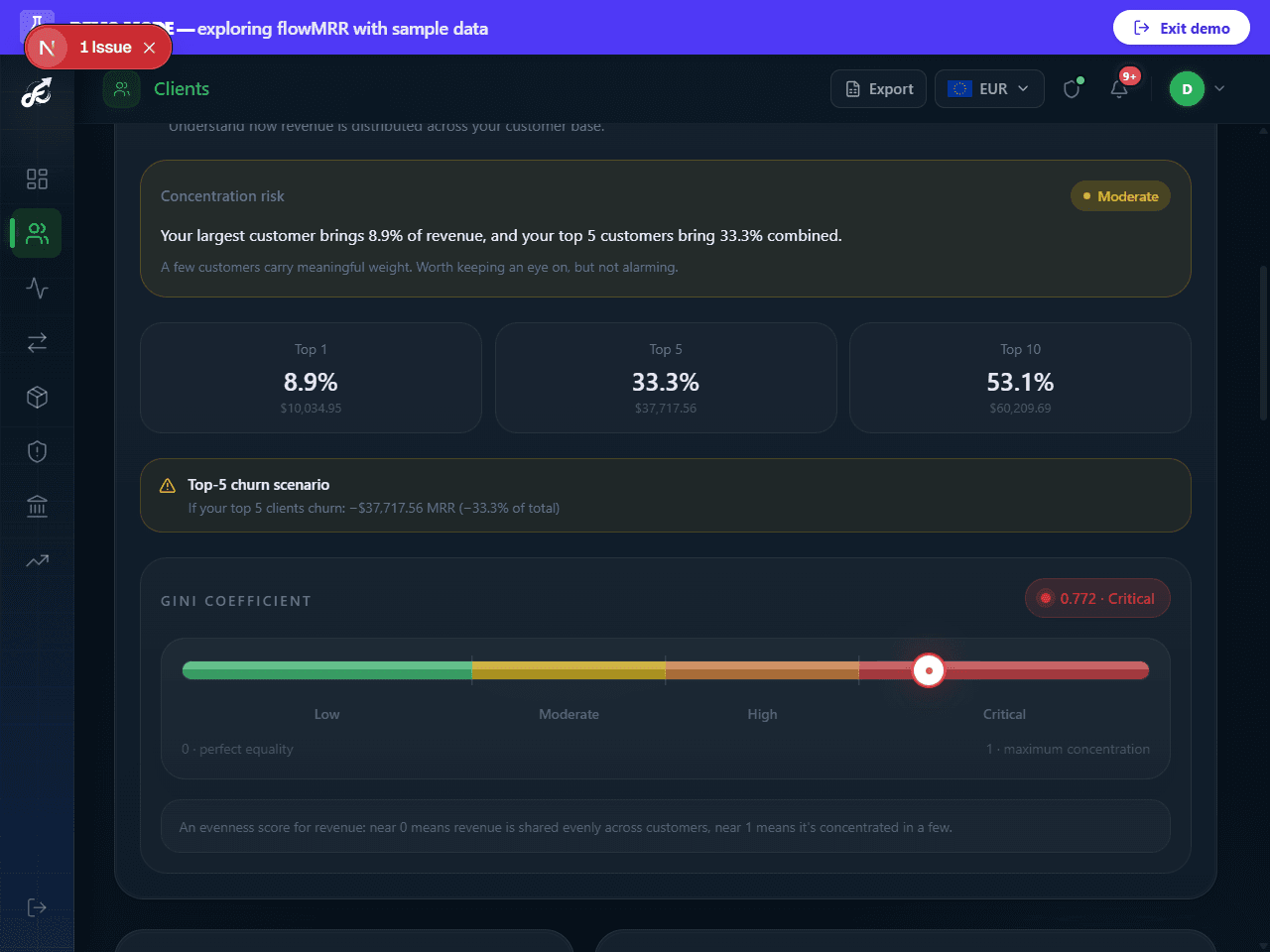
A measure of how evenly your MRR is spread across customers. Two accounts at $50,000 MRR can have wildly different risk profiles: one where the top customer is 2% of revenue, another where it's 40%. Concentration turns a single cancellation into a company-threatening event.
Formula
Gini coefficient (0 = perfectly even, 1 = one account owns everything) + Top 1% / Top 5% of MRRWorked example
$80,000 MRR, top customer pays $18,000/mo (22.5% of MRR), top 5 customers pay $38,000/mo (47.5%) → high concentration. Losing that one account instantly drops MRR by nearly a quarter.
Benchmark
Top-5 share of MRRWhy it matters
Concentration is invisible in a headline MRR number — a business can be growing nicely while quietly becoming a two-customer company. Investors run this exact stress test in diligence ("what happens to ARR if your top account leaves?"), and it should change how you negotiate contracts, set payment terms, and prioritise support for those accounts.
Common mistakes
- Only looking at logo count, not revenue share — 5% of customers can easily be 40% of MRR.
- Never re-running the check after a big new enterprise deal, which is exactly when concentration spikes.
- Treating concentration as purely bad — a few large, sticky accounts can also mean real enterprise traction. The point is to know the number, not to always minimise it.
Tracked in FlowMRR
Clients → Concentration card: Gini coefficient, top-1%/top-5% share and a churn-scenario stress test.