Dunning & Payment Recovery
The art of getting failed payments to succeed without losing the customer.
The process of recovering revenue from failed charges through retries, card updates, and customer outreach. Done well, recovery is the highest-ROI workstream in SaaS — pure margin since there's no acquisition cost.
Worked example
100 failed renewals × $80 average = $8,000 at risk. With 60% recovery (Stripe Smart Retries + card updater + 3-email sequence): $4,800 saved, equivalent to ~$57,600 ARR retained.
Benchmark
Recovery rateWhy it matters
Every $1 recovered through dunning is worth more than $1 of new acquisition because there's zero CAC. The economics are absurd: a well-tuned dunning workflow typically returns 20–40× on the engineering time. Stripe gives you most of the pieces (Smart Retries, Card Account Updater, customer portal) — you just need to wire them and measure.
Common mistakes
- Retrying with fixed intervals instead of using Stripe's adaptive Smart Retries.
- Not enabling Card Account Updater (free, recovers 2–4% of MRR).
- Sending only one dunning email — the third email recovers more than the first in many studies.
- Marking accounts as churned the moment a payment fails — give them the grace period and the retries first.
Tracked in FlowMRR
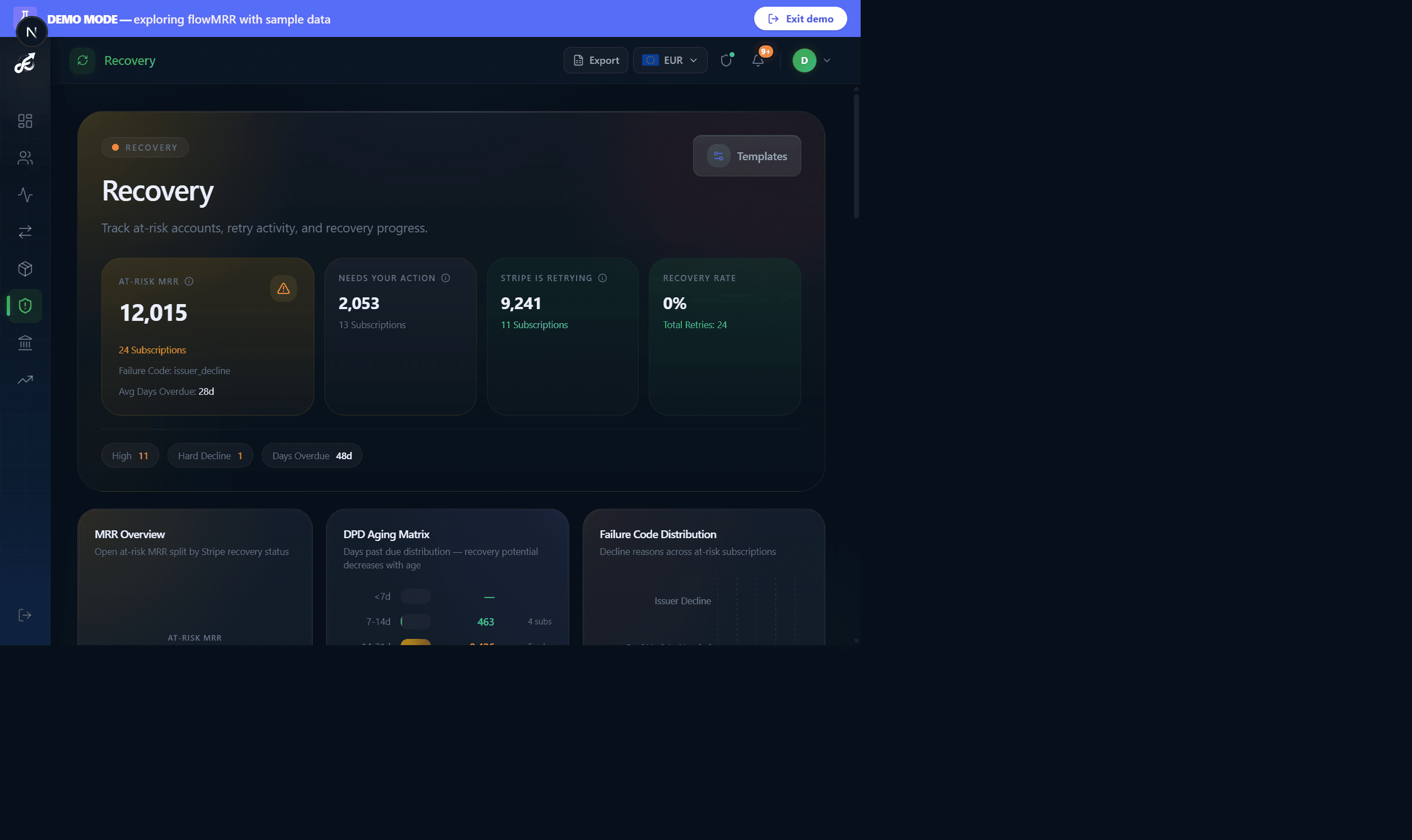
Recovery → aging matrix and retry outcomes, sourced from Stripe's Smart Retries events.