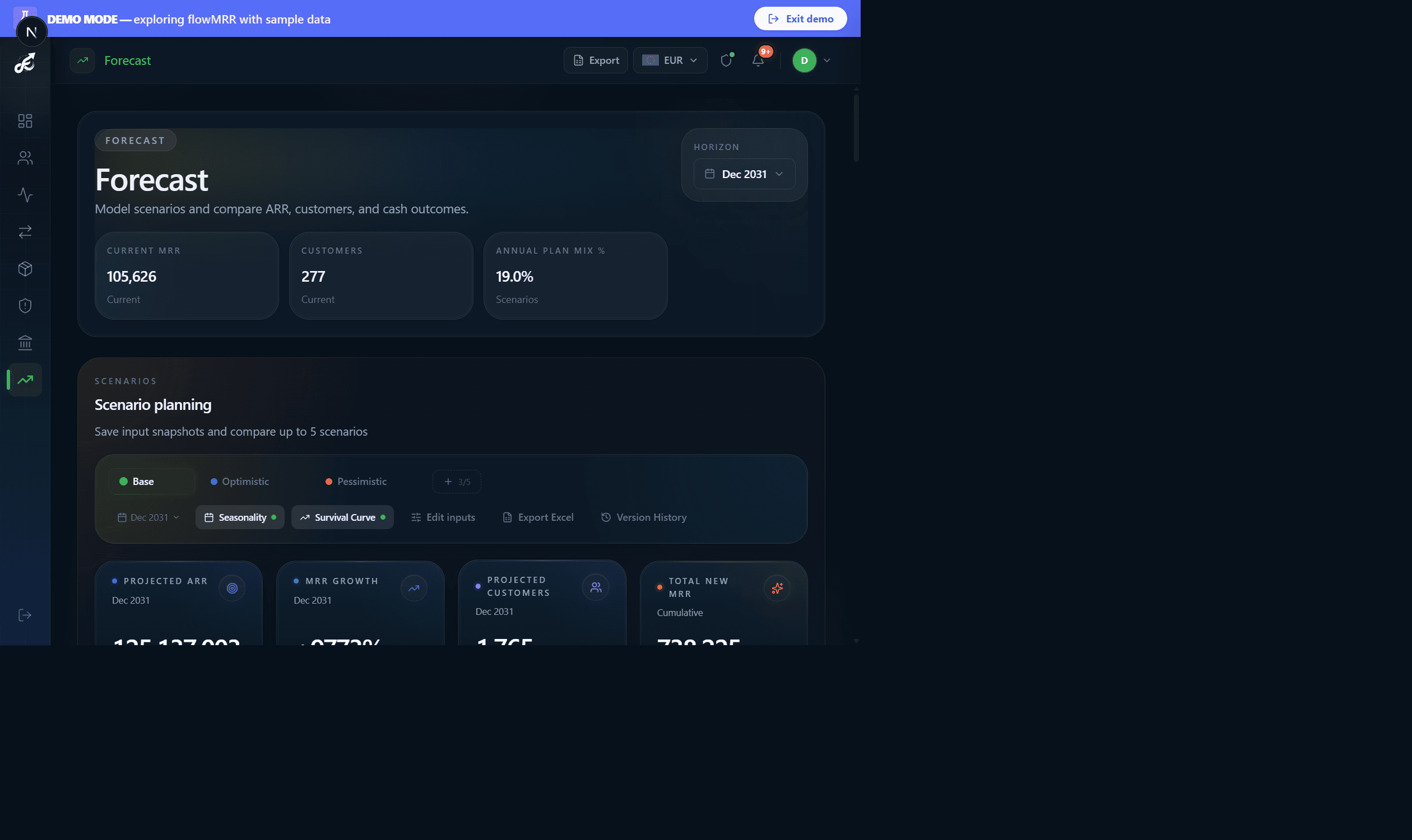
Forecast & Scenario Planning
Three numbers (new, expansion, churn) drive every SaaS forecast.
A forward projection of MRR based on assumptions for new acquisition, expansion rate, and churn rate. The best forecasts are scenario-based: a base, a stretch, and a downside, with the levers explicit so you can react to whichever shows up.
Worked example
Base: 8% new, 1.5% expansion, 2% churn → 18-month MRR doubles. Downside: 5% new, 1% expansion, 3.5% churn → MRR flat. Knowing the gap is what lets you react in February instead of August.
Benchmark
Forecast accuracy (90-day)Why it matters
Forecasting forces you to write down your beliefs about the business. The forecast is rarely right in the absolute, but the discipline of comparing forecast-vs-actual every month is what separates founders who learn from those who guess. Scenario planning also exposes which variable matters most — usually churn, sometimes pricing.
Common mistakes
- Single-scenario forecasts (you cannot act on them; you can only be right or wrong).
- Forecasting in revenue instead of in the underlying drivers (new, expansion, churn).
- Never going back to compare forecast vs actual — you learn nothing.
Tracked in FlowMRR
Forecast → base / stretch / downside MRR scenarios over a 3–24 month horizon.