
FLOWMRR / RECOVERY
Recover Failed Stripe Payments Before They Become Churn
Failed payments are not always lost customers.
See failed payments, at-risk MRR and decline reasons in FlowMRR. Stripe failed payment recovery starts with the accounts that need attention first.
Built on Stripe Connect
Failed payments are not all equal
A failed €20 invoice and a failed €2,000 invoice should not trigger the same follow-up. FlowMRR puts the account and its recurring revenue beside the failure so you can decide where your time matters.
€20 failed invoice: check in Stripe whether a retry is scheduled before contacting the customer.
€2,000 failed invoice: review the account history, decline reason and MRR at risk, then decide whether personal outreach is warranted.
The amounts are examples, not a promise that a payment can be recovered.
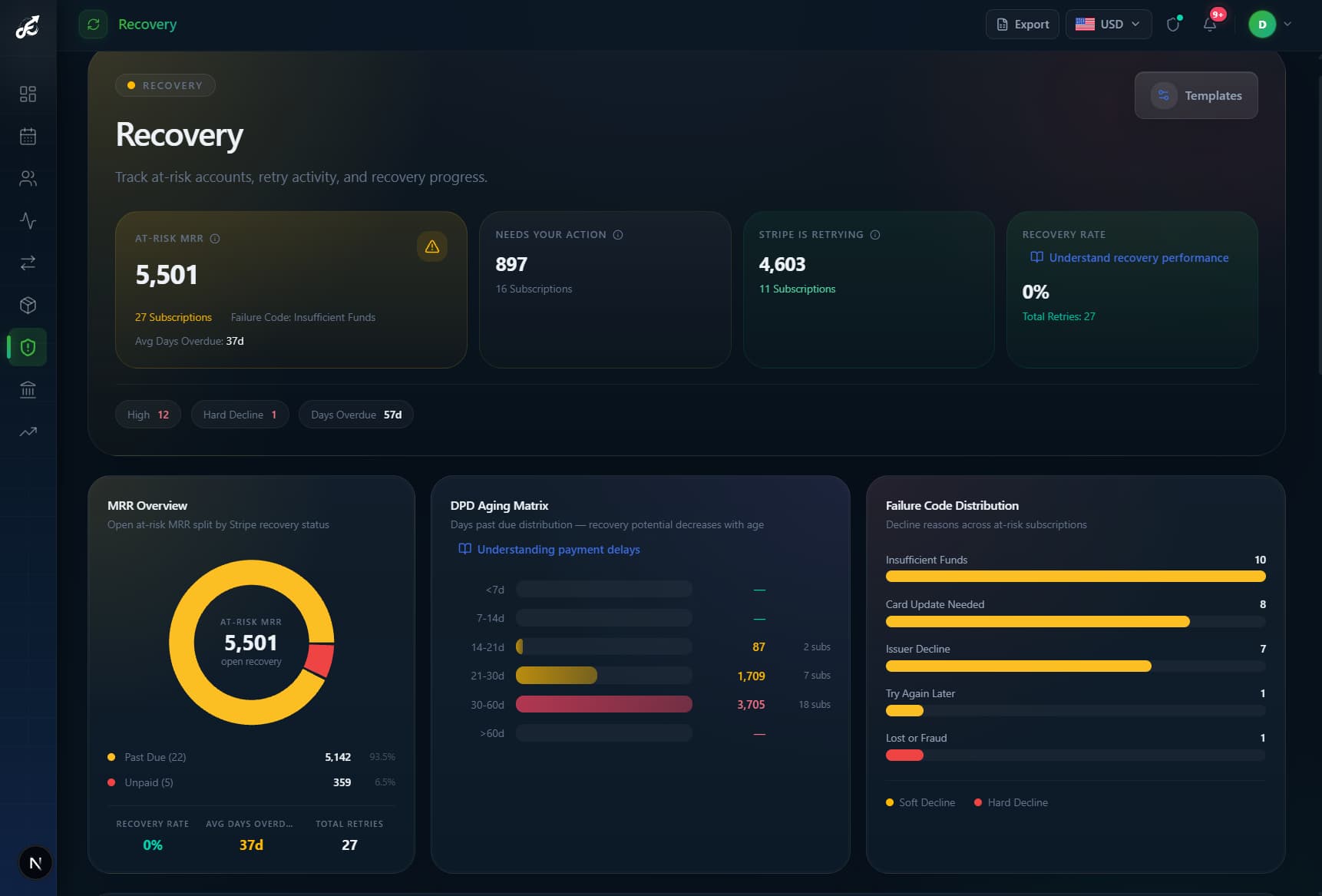
See revenue at risk in one recovery view
Bring past-due subscriptions and follow-up status together. The Recovery area shows at-risk MRR, accounts to review, accounts that appear to still be inside Stripe's retry window, overdue aging and decline reasons. Open an account to inspect its payment and outreach history.
At-risk MRR
Recurring revenue tied to past-due and unpaid subscriptions.
Needs your action
Separate accounts to review from those that appear to still be inside Stripe's retry window.
Failure patterns
Review decline reasons, overdue days and retry counts.
Prioritize failed payment recovery with a score
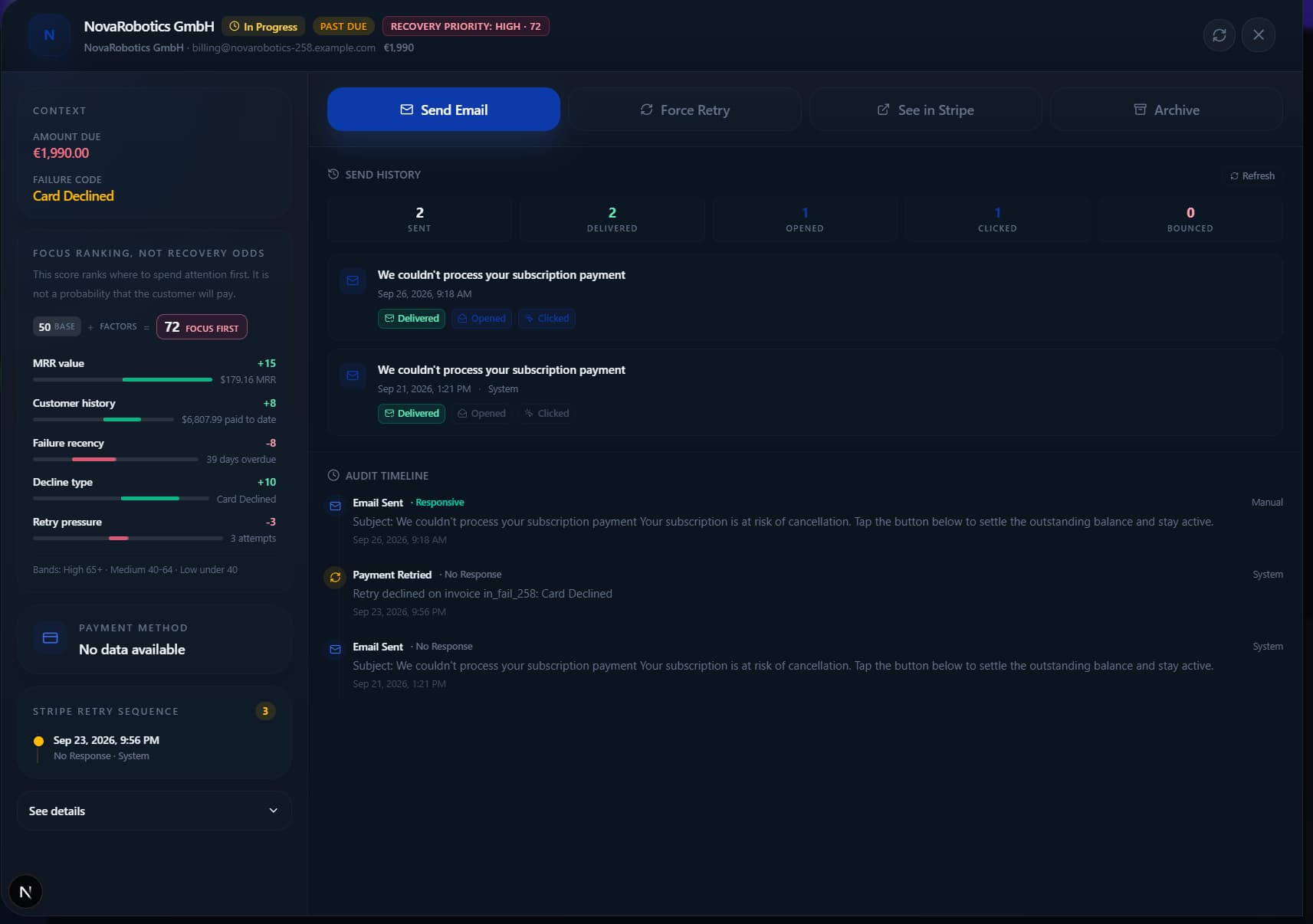
Focus first on the failed payments that matter most. FlowMRR gives at-risk accounts a transparent priority score to help you sort follow-up, not a prediction that recovery is guaranteed.
Revenue and customer MRR
Put the potential impact of a missed payment in context.
Payment history and recency
Consider prior payments and how long the account has been overdue.
Failure code and attempt count
Weigh the decline code and how many attempts have already been made before choosing a follow-up.
The score is a triage aid, not an AI recovery likelihood or a measure of strategic customer importance. Your team makes the final call.
Understand why a Stripe payment failed
Not every decline calls for the same response. The recorded failure reason helps you choose between waiting for a retry, asking for a new payment method and reviewing the account directly.
Insufficient funds or temporary issue
Check in Stripe whether a retry is scheduled before adding outreach.
Expired or invalid card
A payment-method update may be needed before another attempt.
Authentication or issuer decline
Review Stripe's reason and the account timeline before deciding the next step.
A failed payment is not the same as churn
Involuntary churn can follow an unresolved billing failure even when the customer never chose to cancel. Keep the account visible during retries and follow-up; do not count every decline as a lost subscriber.
Build a smarter recovery workflow
FlowMRR helps you structure the human side of SaaS payment recovery: find what is overdue, prioritize the right accounts and use the payment timeline before reaching out.
- 01
Prioritize
Use at-risk MRR and the score to choose which accounts to examine first.
- 02
Check Stripe's next move
Confirm in Stripe whether a retry is scheduled before contacting the customer.
- 03
Follow up deliberately
Review the reason and account history; use available manual actions where appropriate.
- 04
Recheck the outcome
Stop manual follow-up once the payment is resolved instead of treating the customer as lost.
Automatic recovery sequences are not presented as a live FlowMRR feature. Stripe controls its own billing retries; FlowMRR supplies context for your team's decisions.
Analyze failed paymentsMeasure the recovery signals that are available today
See how much recurring revenue is at risk and the recovery rate shown in the Recovery overview. The rate counts subscriptions recovered versus failed; it is not the share of MRR recovered or the success rate of retries. Overdue aging and failure codes add context.
At-risk MRR
See the recurring revenue exposed to failed collection.
Recovery rate
Recovered subscriptions as a share of recovered plus failed; unresolved cases are excluded.
Overdue and decline mix
Use aging and failure codes to interpret what still needs attention.
Stripe retries payments. FlowMRR adds revenue context.
Stripe runs billing infrastructure and may schedule its own retries. FlowMRR complements that workflow with account-level SaaS revenue context, so you can spot accounts to review and confirm in Stripe whether a retry is scheduled.
Stripe
Billing, decline details and any scheduled retries.
FlowMRR
At-risk MRR, priority scoring and account follow-up context.
Want a quick view before connecting your workspace?
The free Recovery tool gives a point-in-time snapshot of at-risk MRR with a prioritized account list. For ongoing account history and follow-up, move to FlowMRR Recovery.
Made for teams that own recurring revenue
Payment recovery for SaaS works best when billing signals are visible to the people who can act on them.
Founders and operators
Know which failed payments could change the revenue picture.
Finance and fractional CFOs
Separate potential collection loss from a confirmed cancellation.
RevOps and subscription teams
Prioritize follow-up with customer and payment context.
Failed payment recovery: common questions
What is failed payment recovery?
It is the process of identifying an unsuccessful payment, checking whether it can be retried and following up before an otherwise active customer is lost.
How does failed payment recovery work with Stripe?
Stripe records payment failures and may retry eligible payments. FlowMRR uses connected Stripe data to show at-risk recurring revenue, retry counts and accounts to review.
What is involuntary churn?
It is customer loss caused by a billing failure rather than a deliberate cancellation. One failed attempt alone does not prove that a customer has churned.
Can failed payments be recovered automatically?
Depending on its settings, Stripe can retry eligible payments. FlowMRR helps you prioritize and review accounts but does not run automatic recovery sequences.
How does FlowMRR prioritize failed payments?
Its priority score uses customer MRR, past spend, time overdue, failure code and the number of attempts already made to help you sort accounts for review.
What is revenue at risk?
It is recurring revenue associated with subscriptions that are past due or unpaid. It is exposure, not an amount already lost or guaranteed to be recovered.
Does FlowMRR replace Stripe Smart Retries?
No. Stripe handles its own retries; FlowMRR adds account context and prioritization for your team.
What is the difference between payment recovery and dunning?
Payment recovery is the broader effort to resolve failed payments. Dunning usually refers to reminders and follow-up communication within that effort.
Does FlowMRR work directly with Stripe?
FlowMRR connects through Stripe Connect. Review the requested permissions before authorizing access.
Can I try recovery analysis for free?
Yes. The free Recovery tool provides a quick snapshot; the connected FlowMRR workspace adds ongoing account-level context.
Recover revenue before it becomes churn.
Find the failed payments that need your attention and decide what to do next in FlowMRR.